

A small maintained handbook built around real questions and operating responsibilities.
Documentation earns its place when it makes work easier or safer. A large public handbook can be useful inspiration, but copying its structure creates obligations your organization may not need. Begin with the questions people repeatedly ask and the decisions that are expensive to reconstruct.
Start from repeated questions and fragile knowledge
Collect questions from onboarding, support, incident response, and routine team work. Look for answers that currently depend on finding one particular person. Prioritize the topics whose absence causes delay, risk, or inconsistent treatment: access, deployment, ownership, escalation, hiring, and how a decision becomes binding.
Write the smallest page that allows someone to act. Name its audience, the task, prerequisites, current steps, and where to get help. A broad statement of values may be useful context, but it does not replace the instructions for a concrete process. Link to the authoritative answer instead of maintaining competing copies.
Give each document a purpose and an owner
Distinguish a policy, a procedure, a reference, and a decision record. A policy says what is required; a procedure explains how to do it; a reference provides facts; a decision record explains why a choice was made. Mixing them can leave readers unsure whether a paragraph is optional advice or a binding requirement.
Assign an owner who can make or coordinate changes. Record when the page should be revisited: a system change, a process change, an incident, or a review date. Maintenance should follow real operational events where possible. A date stamp alone does not establish that the instructions still work.
Test the document with the person who needs it
Ask somebody unfamiliar with the process to use the page for a real or safe practice task. Watch where they need unstated context, unavailable access, or a private explanation. Update the instructions at the point of confusion. This tests usability more directly than having the author reread their own page.
Make uncertainty and exceptions visible. Explain what to do when a step fails and who has authority to approve an exception. Avoid putting credentials, sensitive customer information, or private personnel details into general documentation. A good handbook also tells people when they need a restricted source or a specialist.
Borrow questions, not an entire company
Read public handbooks to discover questions you have not considered. Ask why that organization wrote a particular policy and which assumptions it makes about team size, geography, product, and operating model. A useful practice can become expensive bureaucracy when transplanted without those conditions.
Keep your own handbook connected to normal work. Link it from onboarding and relevant tools, accept corrections where people encounter the problem, and remove obsolete instructions. When two pages disagree, resolve ownership instead of adding a third explanation. The goal is a dependable place to find the current answer, not a display of documentation volume.
Write the page that removes the private message
- Before requesting
- Required training and prerequisites
- Who approves
- The named access owner
- What is granted
- Scope and expiration
- How to verify
- A confirmation and emergency path
The access owner updates the page when the process changes.
Put it to work
0 of 7Use these prompts to check your next step. Your marks stay on this device.
Watch for these failure modes
- Copying another company’s policy without its context.
- Measuring documentation success by page count.
- Treating a recent edit date as proof that a procedure works.
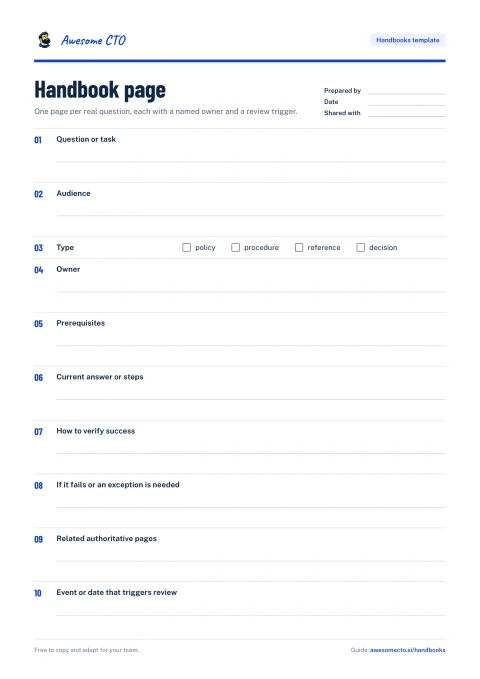
Handbook page
One page per real question, each with a named owner and a review trigger.
10 prompts: Question or task, Audience, Type, and 7 more.
Handbooks resources
Open the original work directly. Our notes explain what each resource contributes and where its advice needs context.
Basecamp Employee Handbook
A public employee handbook to study for how an organization writes down its own working expectations.
Startup CTO's Handbook
A long-form startup CTO reference that can be read by topic rather than only from cover to cover.
GitLab Talent Acquisition Framework
The current public hiring handbook, connecting candidate experience, interviewer preparation, and recruiting responsibilities.
A Manager’s Bill of Responsibilities (and Rights)
A clear statement of what managers owe their teams and the support managers should receive in return.
Software Engineering at Google
A free book about keeping a codebase healthy over time: engineering culture, processes, tools, and the tradeoffs that come with scale.
Atlassian Team Playbook
A library of facilitated team exercises covering goals, decisions, planning, and knowledge sharing. Best used by picking a specific play for a specific problem.
Architecture Decision Record
A compact explanation of recording one consequential architectural decision, its context, consequences, and later superseding decisions.
Software Engineering Blogs
A directory of company and individual engineering blogs for finding first-hand technical accounts beyond the same handful of frequently shared articles.
Valve Handbook for New Employees
The illustrated 2012 employee handbook describing Valve’s flat organization, self-directed projects, peer feedback, and approach to hiring.
Draw The Owl and Other Company Values You Didn’t Know You Should Have
An account of the gap between declaring company values and making them visible in decisions and behavior.
GitLab Engineering Management
A live public chapter on engineering management, including onboarding, backup coverage, and technical credibility.