

A problem brief with shared ownership of risks and a testable account of what success means.
A feature request often arrives with the solution already embedded in it. Engineering can help more when it understands the underlying problem early enough to change the approach. That requires a clear mandate and a working relationship across product, design, engineering, and the people closest to customers.
Separate the request from the problem
Take one roadmap item and ask who needs it, what they are trying to accomplish, what happens today, and what evidence shows the problem matters. Look at support conversations, observed behavior, and commercial context. Keep individual requests visible without assuming that the loudest customer represents every user.
Write the intended outcome so several solutions could plausibly achieve it. “Allow account owners to understand why an invoice changed” leaves room for an explanation, a history view, or a corrected workflow. “Build an analytics dashboard” commits the interface before the underlying uncertainty has been examined.
Name the team’s real mandate
Explain which choices the team can make. Can it change the interface, reduce scope, alter the sequence, question the proposed solution, or choose a different problem? A team that receives fixed scope and timing should not also be told it alone owns the customer outcome. Authority and accountability need to match.
Mandates vary by initiative. A regulatory deadline may constrain the outcome and time; an exploratory product area may permit substantial discovery. Make the actual boundaries clear rather than calling every team empowered. Revisit the mandate when new evidence changes the risk or the company’s priorities.
Bring the disciplines together before commitment
Discuss whether people need the result, can use it, will pay or otherwise support the business model, and whether the organization can build and operate it. Product, design, and engineering bring different evidence to these questions. Engineering should contribute feasible alternatives and operating constraints, not arrive only after a solution has been sold.
Reduce the most consequential uncertainty first. That might mean a customer conversation, a small prototype, a test of data availability, or an operational experiment. State what the learning activity should decide. Discovery that produces another backlog without changing a decision has not necessarily reduced the project’s risk.
Agree on the outcome and the guardrails
Choose a measure that reflects the customer’s task and define the population and time window. Add guardrails for harm that the main measure could hide: support burden, reliability, cost, accessibility, or abandonment elsewhere in the journey. Record what result would lead you to continue, change, or stop.
After release, compare what happened with what you expected. A shipped feature is an opportunity to learn, not the end of product ownership. Keep customer feedback and operational evidence connected so the team can distinguish a weak idea from a good idea delivered with a usability or reliability problem.
Test the need behind the requested feature
Keep the genuine customization needs visible while testing the common need.
Put it to work
0 of 7Use these prompts to check your next step. Your marks stay on this device.
Watch for these failure modes
- Giving a team an outcome goal while fixing every solution decision.
- Using one customer request as proof of broad demand.
- Stopping measurement at the release date.
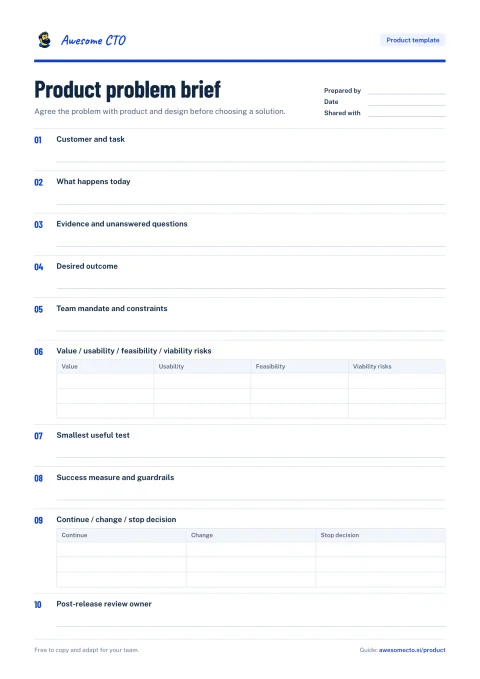
Product problem brief
Agree the problem with product and design before choosing a solution.
10 prompts: Customer and task, What happens today, Evidence and unanswered questions, and 7 more.
Product resources
Open the original work directly. Our notes explain what each resource contributes and where its advice needs context.
Product vs. Feature Teams
An opinionated distinction between delivering a prescribed feature list and owning a customer problem with a cross-functional team.
Mandate Levels
A language for discussing whether a team controls a task, solution, problem, or broader business goal.
How to Hire a Product Manager
An updated classic on evaluating product judgment, technical collaboration, and the ability to work across disciplines.
Shape Up: Stop Running in Circles and Ship Work that Matters
A freely readable book on shaping work, choosing bounded bets, and giving teams room to solve the details.
Implementing SLOs
A hands-on chapter for selecting service-level indicators, defining objectives, and using an error-budget policy to guide reliability work.
PriceOps Awesome List
A focused reading index on software pricing and its implementation, including usage-based models, packaging, and pricing courses.
The North Star Metric
A product-metrics framework centered on a measure of customer value, useful for testing whether a team’s activity measures connect to product outcomes.
Awesome Product Management
A product-management resource index spanning discovery, strategy, delivery, metrics, and practical tools. Useful for finding the product perspective on an engineering decision.
Startup Playbook
A free founder-oriented playbook covering the idea, team, product, execution, growth, hiring, and fundraising, with text and audio on the author’s site.
The Top 10 Deliverables of Product Managers
A concrete view of product work through the artifacts behind vision, strategy, design, and execution.
Execution at Facebook
A first-person explanation of product execution responsibilities and how engineers and product managers divide the inputs.