

A role brief, a prepared interview loop, and a decision rubric tied to the actual opening.
Hiring problems often begin before an interview. An unclear opening attracts the wrong expectations; an overloaded team cannot assess candidates consistently; a vague rubric rewards whoever resembles the interviewer. Design the process from the work the new person needs to accomplish.
Define the need before the profile
Describe what the team will be able to do after the hire that it cannot do now. A senior engineer is not a capability by itself. You might need someone to own a fragile billing subsystem, mentor a growing group, or design a migration while protecting existing customers. Those needs produce different role requirements.
Separate essential evidence from skills that can be learned. Name the support available during onboarding and the constraints that could make the role difficult: time-zone overlap, legacy code, on-call duties, incomplete documentation, or a changing product. If success requires extraordinary independence because nobody can help, first ask whether the organization is ready to hire for that role.
Choose evidence that resembles the job
Create a small rubric before meeting candidates. For each capability, define the exercise or conversation that can reveal it, the observable evidence of a strong answer, and what remains unknown. A design discussion may reveal tradeoff reasoning; a debugging exercise may reveal how someone forms and tests hypotheses. Neither proves every dimension of engineering ability.
Use consistent prompts and record what happened rather than labels such as “not senior enough.” Explain what tools are allowed, including documentation and AI assistance when relevant to your working environment. If you restrict a tool, explain which capability the restriction is intended to reveal. Give candidates the information needed to prepare without expecting unpaid production work.
Prepare the people and the decision
Each interviewer needs a specific assignment so candidates do not repeat the same conversation all day. Agree on duration, prompts, permitted hints, accessibility arrangements, and how evidence will be recorded. Interviewers should write their observations before a group discussion so the most senior voice does not silently determine everybody’s memory.
In the debrief, separate observed evidence, interpretation, and missing information. Resolve disagreement by returning to the role requirements. A new surprise criterion should trigger scrutiny of the process, not an automatic rejection. Keep the final decision owner clear and communicate the outcome within the expectation you set with the candidate.
Make the job assessable from the other side
Candidates are also making a consequential decision. Provide clear information about the team, compensation process, location expectations, interview steps, and the actual work. Let them speak with prospective peers and ask about a recent difficult project. A polished pitch that hides the operational reality creates an onboarding problem later.
Review the process as a funnel, but do not optimize a single conversion number blindly. Look at candidate withdrawals, delays between stages, inconsistent feedback, and the eventual experience of new hires. Ask where the process imposes work without adding evidence. Remove duplicated steps while preserving the checks that matter for the role.
Match the interview to the missing capability
The job: stabilize a data-import service
Investigate a small broken import.
Recover safelyDiscuss retries and duplicate work.
CollaborateExplain a tradeoff with a teammate.
One named capability and rubric for each stage.
Put it to work
0 of 8Use these prompts to check your next step. Your marks stay on this device.
Watch for these failure modes
- Adding more interviewers when the real problem is an undefined rubric.
- Treating rejection as a complete judgment of someone’s ability.
- Advertising autonomy that the team will not actually have.
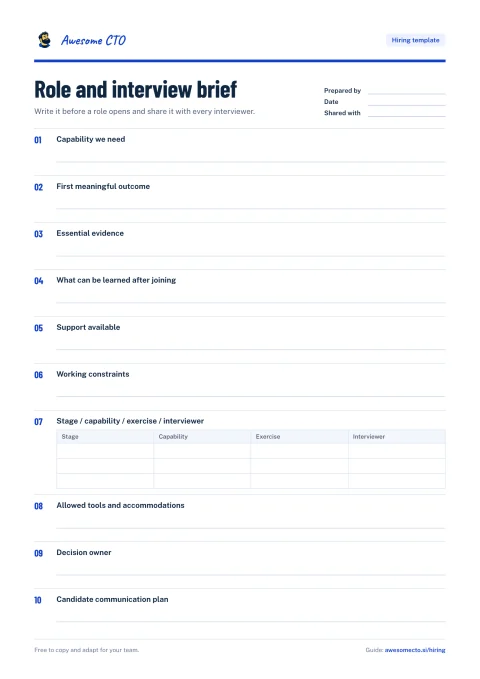
Role and interview brief
Write it before a role opens and share it with every interviewer.
10 prompts: Capability we need, First meaningful outcome, Essential evidence, and 7 more.
Hiring resources
Open the original work directly. Our notes explain what each resource contributes and where its advice needs context.
The Real 11 Reasons I Don't Hire You
Why a capable candidate can still be wrong for a particular opening, team, or moment.
Trouble hiring senior engineers? It's probably you
An employer-side critique of job descriptions and recruiting practices that fail to answer experienced candidates’ questions.
The Guerrilla Guide to Interviewing
A classic argument for evaluating practical programming ability through a deliberate interview process.
Getting the Interview Phone Screen Right
A concrete look at what an early technical screen can establish before a longer interview.
GitLab Talent Acquisition Framework
The current public hiring handbook, connecting candidate experience, interviewer preparation, and recruiting responsibilities.
The Joel Test: 12 Steps to Better Code
A short historical checklist about the working conditions and engineering practices behind a team. Useful prompts for interviewing an employer.
We Hire the Best, Just Like Everyone Else
A challenge to vague “best people” hiring and zero-doubt interview decisions, including the risk of rejecting capable candidates on thin evidence.
How to Interview an Executive
Executive-hiring notes about ownership, strategic reasoning, team gaps, and the difference between creating value and protecting an established business.
How to Become a Magnet for Talent and Assess Talent
Early-startup recruiting notes on making the mission visible, building a candidate pipeline, and actively helping people understand why they should join.
Managing Data Science Teams
A field guide covering data-science hiring, management habits, knowledge sharing, collaboration, and scaling a specialist team.
Rewarding Talent: The Founder’s Guide to Stock Options
A founder-focused stock-options handbook covering allocation policies, employee ownership, geographic differences, and company examples.
Ten Rules for Negotiating a Job Offer
A candidate-side explanation of job-offer negotiation, including leverage, communication, and why advice depends on power and personal circumstances.
Salary Negotiation: Make More Money, Be More Valued
A substantial essay on how technical workers approach compensation discussions, with examples of preparation, framing, and avoidable assumptions.