

An agreed one-page remit and a short list of changes grounded in what the company actually needs.
The title is unusually imprecise. One company wants a technical founder who still builds the product; another needs an executive who runs engineering; another wants a technology strategist who works across divisions. Problems begin when the CEO, the team, and the CTO are doing three different versions of that job.
Start with the company’s constraints
Before drawing an organization chart, learn how the business works. Who pays, why do they stay, and what could prevent the company from succeeding? Trace a real customer request through sales, product, engineering, release, and support. The point is to see where a technical decision changes a business outcome, not to memorize every internal acronym.
Write down the current constraint in plain language. “We cannot onboard larger customers because access controls are inconsistent” gives you a more useful starting point than “we need enterprise architecture.” Keep observations separate from explanations. A slow release might come from fragile tests, unclear approval rights, overloaded reviewers, or work that keeps changing.
Agree on responsibilities and decision rights
Divide your remit into technical direction, engineering operations, people, and executive partnership. For each, name the result you own, the decisions you can make, the people you depend on, and how disagreements are resolved. Owning reliability without control over staffing or release priorities is an accountability gap worth addressing directly.
Have the CEO describe the role independently before comparing notes. Discuss one recent disagreement using the proposed boundaries: who would decide, who would be consulted, and what would be escalated? This exposes ambiguity faster than debating the definition of a CTO. Revisit the agreement after a funding change, a major product shift, or a new senior hire.
Listen before redesigning the organization
A new leader has a brief opportunity to ask basic questions without people assuming a hidden agenda. Ask what should change and what must be preserved. Include engineers, managers, product, support, sales, finance, and the people who handle operational emergencies. Record contradictions instead of averaging them into an agreeable story.
Listening is active work: examine artifacts, follow a deployment, read an incident review, and compare commitments with completed outcomes. Share a short account of what you think you learned and invite correction. Deal with urgent harm immediately; avoid using the listening period as an excuse to leave a dangerous situation untouched.
Change how you create value
If every difficult decision and incident returns to you, the organization is borrowing your attention instead of developing its own capacity. List recurring responsibilities and identify which require your judgment, which need a clearer owner, and which persist only because you have always done them. A handoff needs context, authority, access, and an explicit support period.
Continue technical work where it improves your judgment or removes an unusual constraint. Be careful with owning a critical-path feature that only you can finish while also carrying executive responsibilities. Your most useful contribution may be a better decision process, a capable manager, or a clear boundary that allows many other people to work.
Transfer a responsibility, not just a notification
Document release checks
Train a second owner
Practice rollback
Put it to work
0 of 7Use these prompts to check your next step. Your marks stay on this device.
Watch for these failure modes
- Importing a process from the previous employer before understanding the current one.
- Using the title to avoid negotiation about actual responsibilities.
- Keeping the most interesting engineering work while delegating only administration.
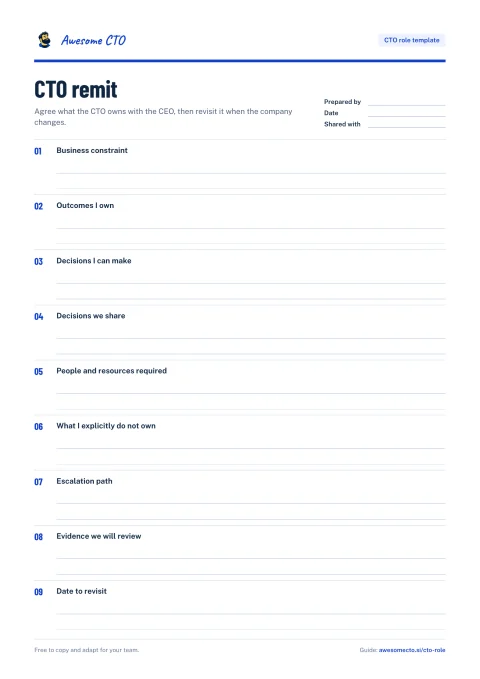
CTO remit
Agree what the CTO owns with the CEO, then revisit it when the company changes.
9 prompts: Business constraint, Outcomes I own, Decisions I can make, and 6 more.
CTO role resources
Open the original work directly. Our notes explain what each resource contributes and where its advice needs context.
The Different CTO Roles
Four different mandates can hide behind the same CTO title. Use them to make your own responsibilities explicit.
Your first 90 days as CTO or VP Engineering
A structured approach to entering an engineering executive role, starting with the business and the organization you inherit.
How to spend your first 30 days in a new senior-level role
A listening tour for new senior leaders, with concrete prompts for learning what people want changed and preserved.
Evolution of my role as a founder CTO
A founder’s account of how architecture, operations, hiring, and management changed as RevenueCat grew.
Rands Leadership Slack
A leadership discussion community for experienced, new, and aspiring managers. Useful when you need peers to test a difficult management question with.
Roles and Responsibilities
A team exercise for making responsibilities, overlaps, and unowned work visible before those gaps cause delivery problems.
Staff Engineer Archetypes
Four patterns of senior technical leadership—tech lead, architect, solver, and right hand—that make a vague staff title easier to discuss.
How to Interview an Executive
Executive-hiring notes about ownership, strategic reasoning, team gaps, and the difference between creating value and protecting an established business.
How to Be an Effective Executive
Notes on executive attention: gathering information, choosing high-impact activities, managing a calendar, and making meetings serve a clear purpose.
Humans in the Loop: Engineering Leadership in a Chaotic Industry
A recorded engineering-leadership talk about AI and automation, the complexity left for people to handle, and the skills leaders should keep developing.
Thinking Like an Architect
A recorded talk about architecture as a way of thinking: connecting levels, sketching, preserving options, using models, and recognizing tradeoffs.
Startup Playbook
A free founder-oriented playbook covering the idea, team, product, execution, growth, hiring, and fundraising, with text and audio on the author’s site.
#define CTO
A first-person account of finding a VP Engineering partner and reshaping the CTO role as Stripe grew.
How to build a startup engineering team
How an engineering leader can adapt large-company experience to a startup without losing the ability to grow.