

A manageable operating rhythm and a concrete agreement about what people can expect from their manager.
Management becomes visible when it fails: decisions stall, feedback arrives too late, and the same person keeps rescuing the work. Effective management creates the conditions for others to act. Its value is clearer when you name those conditions and check whether the team experiences them.
Start with a clear manager agreement
Write down what the manager owns: context, staffing, feedback, development, planning, and resolving obstacles the team cannot resolve alone. Add what the manager needs from their own leader. Holding someone accountable for delivery while leaving conflicting priorities unresolved simply moves the ambiguity down a reporting line.
Use a real situation to test the agreement. If two partners ask for urgent work, who prioritizes it? If an engineer is struggling, who provides feedback and support? If a manager is overloaded, where do they get help? Make the answers accessible to the team so people do not have to infer responsibilities through repeated frustration.
Use one-to-ones for the work around the work
Keep routine status visible elsewhere so a one-to-one can address friction, uncertainty, growth, relationships, and feedback. Maintain a shared agenda where both people can add topics between meetings. Ask about a concrete moment from the week when an open question produces only a polite “everything is fine.”
Do not turn every concern into an instruction. Clarify the situation, ask what the person has tried, and agree whether they want coaching, context, or direct intervention. Record commitments on both sides and revisit them. State the limits of confidentiality clearly rather than making a promise that cannot be kept when a serious issue needs escalation.
Make feedback specific and timely
Describe the observable behavior, its effect, and the change you want to discuss. “The last two handoffs omitted the rollback instructions, so the on-call engineer had to reconstruct them” creates a workable conversation. “Be more senior” leaves the person guessing. Ask for their account before deciding why the behavior occurred.
Formal reviews should consolidate a continuing conversation. They should not be the first time someone hears about a recurring problem. Collect examples across the whole period, including work that is less visible to leadership. Recognize mentoring, incident prevention, and cross-team help alongside feature launches. Calibrate judgments with other managers, while keeping the evidence and expectations visible to the person being reviewed.
Delegate outcomes, boundaries, and support
A useful handoff includes the result, constraints, decision authority, escalation triggers, and the support available. Delegating a task while retaining every decision creates a queue at the manager. Delegating responsibility without authority leaves the recipient exposed. Agree on checkpoints based on risk and experience rather than asking for constant updates.
The team’s calendar also deserves management attention. Give meetings a purpose, written inputs when needed, and a useful output. Protect focused work, but do not eliminate the communication required to coordinate it. Review whether the actual meeting rhythm fits the current team instead of keeping inherited ceremonies indefinitely.
Give autonomy a clear boundary
Own the outcome
The engineer chooses implementation details.
Agree the bounds
Stay within the interface and cost limit.
Review the exceptions
Escalate data ownership or public API changes.
Weekly review replaces repeated permission requests.
Put it to work
0 of 7Use these prompts to check your next step. Your marks stay on this device.
Watch for these failure modes
- Using every one-to-one as a status report.
- Solving every problem personally and calling it support.
- Waiting for a review cycle to deliver important feedback.
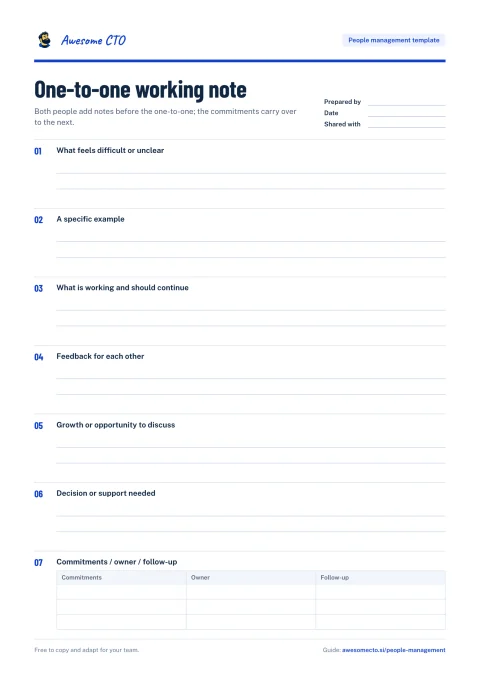
One-to-one working note
Both people add notes before the one-to-one; the commitments carry over to the next.
7 prompts: What feels difficult or unclear, A specific example, What is working and should continue, and 4 more.
People management resources
Open the original work directly. Our notes explain what each resource contributes and where its advice needs context.
A Manager’s Bill of Responsibilities (and Rights)
A clear statement of what managers owe their teams and the support managers should receive in return.
A Review Process
A detailed account of redesigning reviews around shared principles and concrete examples of collaboration.
Meetings for an effective eng organization
A working model for team meetings, technical reviews, development forums, and engineering-wide questions.
Maker's Schedule, Manager's Schedule
Why a meeting that looks small on one calendar can break the working day of someone who needs uninterrupted concentration.
The Engineer/Manager Pendulum
Why moving between engineering and management can build a stronger career than treating management as a one-way promotion.
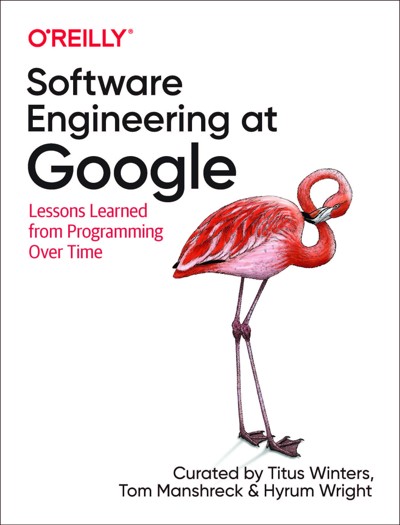
Software Engineering at Google
A free book about keeping a codebase healthy over time: engineering culture, processes, tools, and the tradeoffs that come with scale.
Rands Leadership Slack
A leadership discussion community for experienced, new, and aspiring managers. Useful when you need peers to test a difficult management question with.
Engineering Managers Slack
A peer space for engineering managers, team leads, and others managing people in technology, with explicit confidentiality and conduct rules.
DACI Decision-Making Framework
A facilitated decision exercise that separates the driver, approver, contributors, and people who need to be informed.
Roles and Responsibilities
A team exercise for making responsibilities, overlaps, and unowned work visible before those gaps cause delivery problems.
The Power of Performance Reviews
A performance-review system with preparation, delivery, follow-up, and a reusable template, grounded in the author’s management experience at Airbnb.
After Being a Manager, Can I Be Happy as a Cog?
An advice-column discussion of returning to technical work after management, including status, influence, motivation, and the cost of staying away from practice.
Context Switching Is Destroying Your Workday
An accessible explanation of attention residue and task switching, with practical ways to reduce interruptions in a connected workplace.
How to Be an Effective Executive
Notes on executive attention: gathering information, choosing high-impact activities, managing a calendar, and making meetings serve a clear purpose.
Engineering Management Resources
A broad topic index for engineering management, from one-to-ones and delegation to technical strategy, developer experience, and organizational design.
Managing Data Science Teams
A field guide covering data-science hiring, management habits, knowledge sharing, collaboration, and scaling a specialist team.
How to Structure a Data Science Team
An overview of data-science roles and organizational models, useful when deciding where specialists should sit and how they connect to product teams.
Valve Handbook for New Employees
The illustrated 2012 employee handbook describing Valve’s flat organization, self-directed projects, peer feedback, and approach to hiring.
Peopleware: Productive Projects and Teams
A classic book about the human side of software projects: working conditions, team formation, leadership, and the organizational obstacles to useful work.
Generous, High Fidelity Communication
A recorded talk connecting generous communication, disagreement, and just culture to the conditions that help a team raise concerns and work safely.
Hacking team communications
A practical account of using existing work channels to reduce repeated status requests and expose work earlier.
A Tactical Guide to Managing Up
A collection of concrete approaches to aligning expectations and improving the working relationship with a manager.
Hold Your Team Accountable
A coaching approach to accountability that emphasizes inquiry and clear expectations instead of taking the work back.
GitLab Engineering Management
A live public chapter on engineering management, including onboarding, backup coverage, and technical credibility.