

A career conversation grounded in observable expectations and a supported growth opportunity.
A ladder cannot make performance objective, but it can make expectations less mysterious. Its job is to help people understand the work, discuss growth, and challenge inconsistent judgments. Start with the responsibilities your company actually needs rather than borrowing the titles of a larger organization.
Describe work before assigning levels
Collect examples of meaningful contribution: owning a service, improving a difficult system, coordinating several teams, mentoring a colleague, or reducing an operational risk. Describe the scope, independence, judgment, and collaboration each example required. Then ask which distinctions recur often enough to be useful in a career framework.
Keep technical and management progression visible as different kinds of work. A person should not need direct reports to demonstrate growing influence. Be careful with language such as “company-wide impact” in a small organization where almost every change reaches everyone. Define what the responsibility means in your context instead of relying on the apparent prestige of the phrase.
Separate performance, growth, and promotion
Performance concerns the expectations of the current role. Growth concerns developing capability. Promotion also depends on the role and scope the organization can support. Mixing all three creates misleading promises: someone may grow substantially without a new title being available, or occupy broader scope without receiving clear expectations.
Explain the process and timing before the review. Name who proposes a promotion, what evidence is considered, who calibrates it, and how a person can question the outcome. Compensation discussions need their own clear process. Do not disguise a budget limit as a personal development deficiency.
Collect evidence without creating a second job
Use normal work artifacts: design discussions, incident reviews, customer outcomes, peer collaboration, and decisions that helped other people move forward. Record the person’s contribution and context so a team result is not attributed solely to the most visible presenter. Include the maintenance and prevention work that leaves fewer dramatic artifacts.
A manager should maintain this account with the employee throughout the period. Calibration then tests whether similar evidence produces similar judgments across teams. Ask what opportunities each person had, not only what they delivered. A framework is unfair if one person receives the necessary scope and another is told to demonstrate it without access to suitable work.
Turn the conversation into an opportunity
Choose one or two capabilities to develop and identify work where the person can practice them. Specify support, boundaries, and how you will review the experience. “Show more leadership” is not a plan; leading a bounded cross-team migration with a sponsor and feedback checkpoints is closer to one.
Revisit the framework when the company changes. Remove distinctions that managers cannot explain consistently and add examples where the same ambiguity keeps returning. A small understandable framework that people use is more valuable than a large competency matrix nobody can interpret without a private explanation.
Make the opportunity observable
Lead a shared API change
- Support
- A senior sponsor
- Scope
- Design, rollout, and stakeholder feedback
- Evidence
- Decisions, communication, and the result
Put it to work
0 of 7Use these prompts to check your next step. Your marks stay on this device.
Watch for these failure modes
- Importing a large-company ladder with no matching scope.
- Using promotion language to conceal a compensation constraint.
- Requiring evidence of opportunities the person has never been offered.
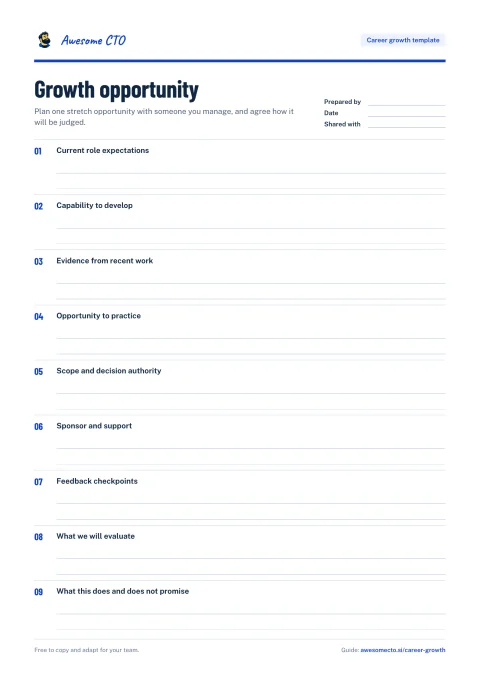
Growth opportunity
Plan one stretch opportunity with someone you manage, and agree how it will be judged.
9 prompts: Current role expectations, Capability to develop, Evidence from recent work, and 6 more.
Career growth resources
Open the original work directly. Our notes explain what each resource contributes and where its advice needs context.
Software Engineering Ladders
An explicit career model spanning developers, tech leads, program managers, and engineering managers.
Should I Become a Manager?
A practical reflection on choosing management and understanding what changes when the team’s work becomes your responsibility.
Reverse Interview Questions
Questions candidates can ask about work, culture, delivery, and the company they might join.
Practical Deep Learning for Coders
A free, code-first deep-learning course covering vision, language, tabular models, and deployment. A useful hands-on route for an engineering leader returning to ML.
Dropbox Engineering Career Framework
A public company career framework to compare expectations and discuss engineering growth in concrete terms.
Staff Engineer Archetypes
Four patterns of senior technical leadership—tech lead, architect, solver, and right hand—that make a vague staff title easier to discuss.
Staff Engineer: Leadership Beyond the Management Track
Interviews and guides about staff-plus engineering, useful for developing technical leadership without making management the only path forward.
The Power of Performance Reviews
A performance-review system with preparation, delivery, follow-up, and a reusable template, grounded in the author’s management experience at Airbnb.
After Being a Manager, Can I Be Happy as a Cog?
An advice-column discussion of returning to technical work after management, including status, influence, motivation, and the cost of staying away from practice.
Awesome Engineering Ladders
An index of public engineering ladders, articles, frameworks, and presentations, including examples from Dropbox, Etsy, and other organizations.
Developer Roadmaps
Interactive learning maps for engineering disciplines and technologies, useful for structuring self-study or identifying unfamiliar areas.
Ten Rules for Negotiating a Job Offer
A candidate-side explanation of job-offer negotiation, including leverage, communication, and why advice depends on power and personal circumstances.
Salary Negotiation: Make More Money, Be More Valued
A substantial essay on how technical workers approach compensation discussions, with examples of preparation, framing, and avoidable assumptions.
How to Prepare a Talk
A practical preparation process built around speaking and rehearsing the talk, rather than mistaking silent slide-writing for performance practice.
Humans in the Loop: Engineering Leadership in a Chaotic Industry
A recorded engineering-leadership talk about AI and automation, the complexity left for people to handle, and the skills leaders should keep developing.
Undervalued Software Engineering Skills: Writing Well
Why clear writing becomes a practical engineering skill as teams and responsibilities extend beyond immediate peers.
Software Engineers Growth framework
A historical explanation of replacing a career framework as a company’s size and team structure changed.