

A bounded project brief, explicit dependencies, and an operating view that explains progress and risk.
Unpredictable delivery is rarely explained by one missing ceremony. Priorities change, work waits on decisions, dependencies arrive late, and projects contain discoveries that were never visible in the plan. Begin by tracing a real piece of work from request to use.
Find where the work actually waits
Choose several recently completed changes and record the sequence: request, clarification, design, implementation, review, release, and observation in use. Separate active work from waiting. Note where scope changed or a decision was reopened. Ask the people involved to explain the delays before attaching a process label to them.
This gives you a specific improvement target. A queue at one reviewer needs a different intervention from unclear acceptance criteria or a release process nobody trusts. More detailed estimates will not repair an unresolved dependency. Preserve the distinction between learning something new and failing to execute work that was already understood.
Shape a complete useful result
Write the customer or operational problem, the evidence that it matters, the investment boundary, and what a useful outcome looks like. Include what is outside scope. A proposal that promises a feature name without explaining its boundaries leaves important choices until after the commitment has already been made.
Treat appetite and forecast as different concepts. Appetite says how much investment the problem merits. A forecast says what appears possible under stated assumptions. When they do not match, change scope, learn more, or choose another investment. Do not force the forecast to equal the budget by removing uncertainty from the language.
Resolve dependencies before making a promise
For each external dependency, name the deliverable, owner, expected handoff, and consequence of delay. Include internal dependencies such as a security review, a product decision, or access to realistic test data. A dependency is still present when everybody works for the same company.
When work is unfamiliar, separate the question you need answered from the implementation that follows. A small investigation should produce a decision, evidence, or a narrower forecast. Review assumptions when tools, team composition, or the nature of the work changes; old delivery histories may no longer represent the system you are planning.
Measure to operate and decide
Keep a short operating view of intended outcomes, completed outcomes, work in progress, aging dependencies, and operational health. Choose measures that can trigger a decision. A rising review queue might prompt a change in ownership; an increase in incidents might change the release plan. Explain the interpretation alongside the number.
For leadership reporting, connect progress to business consequences and the next decision. Avoid presenting activity as impact. A large number of merged changes does not show whether customers can complete the task they needed. Review the forecast as evidence arrives and communicate a changed assumption before it turns into a surprise deadline.
Define a useful finish line
“Launch reporting” becomes a bounded result.
In this delivery
Finance can export last month’s invoices with documented totals.
Resolve first: reconciliation testOutside this delivery
Custom dashboards and historical restatement.
Put it to work
0 of 7Use these prompts to check your next step. Your marks stay on this device.
Watch for these failure modes
- Treating every delay as an estimation problem.
- Committing to a date while leaving the outcome undefined.
- Comparing individual engineers through ticket or commit counts.
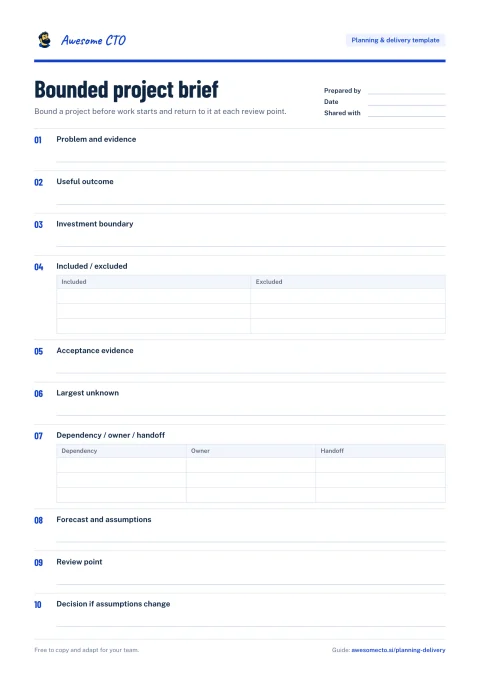
Bounded project brief
Bound a project before work starts and return to it at each review point.
10 prompts: Problem and evidence, Useful outcome, Investment boundary, and 7 more.
Planning & delivery resources
Open the original work directly. Our notes explain what each resource contributes and where its advice needs context.
The Secret to a Great Planning Process — Lessons from Airbnb and Eventbrite
A planning sequence that moves between leadership context and team proposals before committing the organization.
Measuring an engineering organization
A decision-based approach to engineering measurement, separating operating needs from different stakeholders’ questions.
Evidence Based Scheduling
A historical approach to forecasting delivery using recorded estimates and actual outcomes.
Shape Up: Stop Running in Circles and Ship Work that Matters
A freely readable book on shaping work, choosing bounded bets, and giving teams room to solve the details.
DACI Decision-Making Framework
A facilitated decision exercise that separates the driver, approver, contributors, and people who need to be informed.
Retrospective
A runnable retrospective play for reflecting on recent work and choosing improvements, with preparation and facilitation instructions.
Continuous Delivery
A capability guide to keeping software deployable and making releases low risk, with a clear distinction between delivery and automatic deployment.
Database Change Management
How versioned database changes, shared visibility, and communication make schema work part of software delivery rather than a separate release bottleneck.
The Joel Test: 12 Steps to Better Code
A short historical checklist about the working conditions and engineering practices behind a team. Useful prompts for interviewing an employer.
Context Switching Is Destroying Your Workday
An accessible explanation of attention residue and task switching, with practical ways to reduce interruptions in a connected workplace.
A Successful Git Branching Model
The original Gitflow explanation, including the author’s later advice to prefer a simpler workflow for continuously delivered applications.

The Mythical Man-Month
Essays on large software projects, coordination costs, conceptual integrity, and why adding people is not a simple cure for a late project.
Continuous Delivery
The book-length treatment of deployment pipelines, build and test automation, configuration, data changes, and collaboration across delivery roles.
Cycle times
An organizational view of cycle time: decision layers, meeting size, ownership, and repeated loops.
Individuals matter
A critique of roadmaps and staffing systems that assume people with the same title are interchangeable capacity.