

A concise engineering update and a maintained evidence folder for important claims.
Other executives do not need every implementation detail, but they do need an accurate account of what engineering enables, what constrains the plan, and which choices require their involvement. Credibility comes from connecting technical facts to consequences without hiding uncertainty.
Begin with the decision the audience owns
A board update, a finance review, and a product planning discussion are different conversations. Identify what the audience needs to decide before choosing the detail. A board may need to understand progress against the business plan and material risks. Finance needs a dependable account of spending and commitments. Product needs feasible alternatives and consequences.
Build these views from the same operating facts. If the team’s internal picture differs radically from the executive report, investigate why. Report changes in assumptions directly. A candid explanation of a constraint and the decision it requires is more useful than a reassuring percentage-complete figure with no clear basis.
Explain investment through outcomes and obligations
Separate committed operating costs, planned hiring, vendor spending, and proposed investments. Explain the assumptions behind a forecast and who owns the input. Include the work that keeps the business operating: reliability, security, support, and maintenance. Treating all engineering capacity as available feature capacity makes the plan fragile.
For an investment proposal, compare credible alternatives, including doing less or delaying. State the expected benefit, the consequence of not acting, the uncertainty, and how progress will be reviewed. Avoid pretending that every technical improvement can be reduced to a precise financial return. Some investments protect an essential capability or remove a risk that needs an explicit business judgment.
Make diligence an evidence exercise
Prepare a current system map, ownership map, deployment and recovery explanation, important vendor dependencies, and a factual account of known risks. For material claims, identify supporting artifacts and exceptions. “We can restore customer data” needs more than a backup setting; a dated restore result is stronger evidence.
Separate what exists from what is planned. An honest known gap with an owner and remediation plan is easier to assess than a polished claim that collapses under a follow-up question. Share sensitive material through appropriate access controls. Technical preparation helps the process, but transaction-specific legal, financial, and regulatory conclusions need the relevant professional review.
Keep the executive update short but substantive
Lead with what changed: an outcome achieved, a material risk, or a decision needed. Give enough evidence to assess the claim, explain the consequence, and state the next action and owner. Put implementation detail behind the main account so interested readers can inspect it without forcing everyone through the same depth.
Preserve a record of previous decisions and the assumptions attached to them. This helps the organization learn when a plan changes and prevents the same debate from restarting with a different memory. Use a regular review to retire resolved risks and elevate new ones rather than carrying an ever-growing list of concerns.
Give the decision maker the evidence they need
The decision: invest in an infrastructure migration?
Outcome
Reduce customer onboarding failures during peak demand.
Evidence
Observed failures and the operating cost change.
Alternatives
Compare two approaches and their obligations.
Verification
Agree how the risk reduction will be tested.
Put it to work
0 of 7Use these prompts to check your next step. Your marks stay on this device.
Watch for these failure modes
- Reporting activity as business impact.
- Hiding a changed assumption until the deadline fails.
- Answering diligence questions with plans written in the present tense.
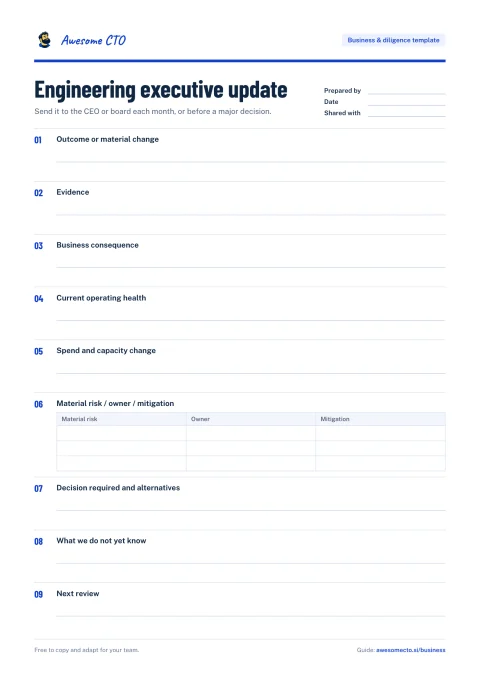
Engineering executive update
Send it to the CEO or board each month, or before a major decision.
9 prompts: Outcome or material change, Evidence, Business consequence, and 6 more.
Business & diligence resources
Open the original work directly. Our notes explain what each resource contributes and where its advice needs context.
Measuring an engineering organization
A decision-based approach to engineering measurement, separating operating needs from different stakeholders’ questions.
Technology Due Diligence Checklist
A broad diligence question set spanning product, organization, scalability, and AI/ML operating responsibilities.
Technical Due Diligence Questions
Questions that connect technical due diligence to the business, product, team, and ability to operate the system.
A Guide to Seed Fundraising
A founder-oriented explanation of seed fundraising and the preparation behind telling a company’s story.
Awesome Billing
An engineering-oriented index of pricing, billing, accounting, invoices, payments, tax, fraud, and the systems that connect them.
PriceOps Awesome List
A focused reading index on software pricing and its implementation, including usage-based models, packaging, and pricing courses.
Rewarding Talent: The Founder’s Guide to Stock Options
A founder-focused stock-options handbook covering allocation policies, employee ownership, geographic differences, and company examples.
The North Star Metric
A product-metrics framework centered on a measure of customer value, useful for testing whether a team’s activity measures connect to product outcomes.
Startup Playbook
A free founder-oriented playbook covering the idea, team, product, execution, growth, hiring, and fundraising, with text and audio on the author’s site.
The One Key to Dealing with Senior Executives: Answer the Question!
A concrete reminder to answer the question an executive actually asked before adding background and qualifications.
GitLab Financial Planning & Analysis
A current public view of financial planning and analysis, including forecasting, business drivers, and cross-functional planning.